Introduction
Hypertension often progresses without symptoms. Patients may feel well even when blood pressure is repeatedly elevated, yet delayed recognition can contribute to stroke, myocardial infarction, heart failure, chronic kidney disease, and other preventable harms. Early recognition and timely follow-up are therefore important patient safety goals.1
Community settings outside conventional medical clinics may also help identify elevated blood pressure. In a cluster-randomized trial, Victor et al. showed that a trusted community setting could support blood pressure reduction through a structured intervention.2 Although that study used a pharmacist-led treatment model in Black barbershops, it established an important principle: Repeated community contact can contribute to blood pressure safety when clear protocols and medical follow-up are in place.2,3
Acupuncture clinics often see patients repeatedly for musculoskeletal complaints. These visits may also reveal broader health risks that are not the patient’s main reason for attendance. However, nonphysician clinics do not always have an explicit method for deciding when repeated abnormal vital signs should lead to physician evaluation, how that decision should be documented, or how to communicate it clearly to the receiving doctor.
This report describes a small patient safety intervention implemented in a solo acupuncture clinic. The aim was not to diagnose hypertension or manage medication. The aim was to make repeat measurement, referral, and hand-off more consistent and less dependent on individual documentation skill. AI was used to support the structuring of red-flag prompts and the organization of clinical information, but all final clinical judgment remained with the author.4,5
Workflow and Methods
Clinical setting
This case occurred in a solo acupuncture and moxibustion clinic in urban Japan. The clinic mainly provides conservative care for musculoskeletal complaints. When clinically indicated, intake also includes selected lifestyle history and basic vital signs.
Workflow overview
The workflow was designed to answer a practical question: When should a nonphysician clinic continue local conservative care while also adding physician evaluation?
The sequence was:
-
Initial intake and symptom review
-
Red-flag screening
-
In-clinic blood pressure measurement when indicated
-
Standardized repeat measurement if the initial value was elevated
-
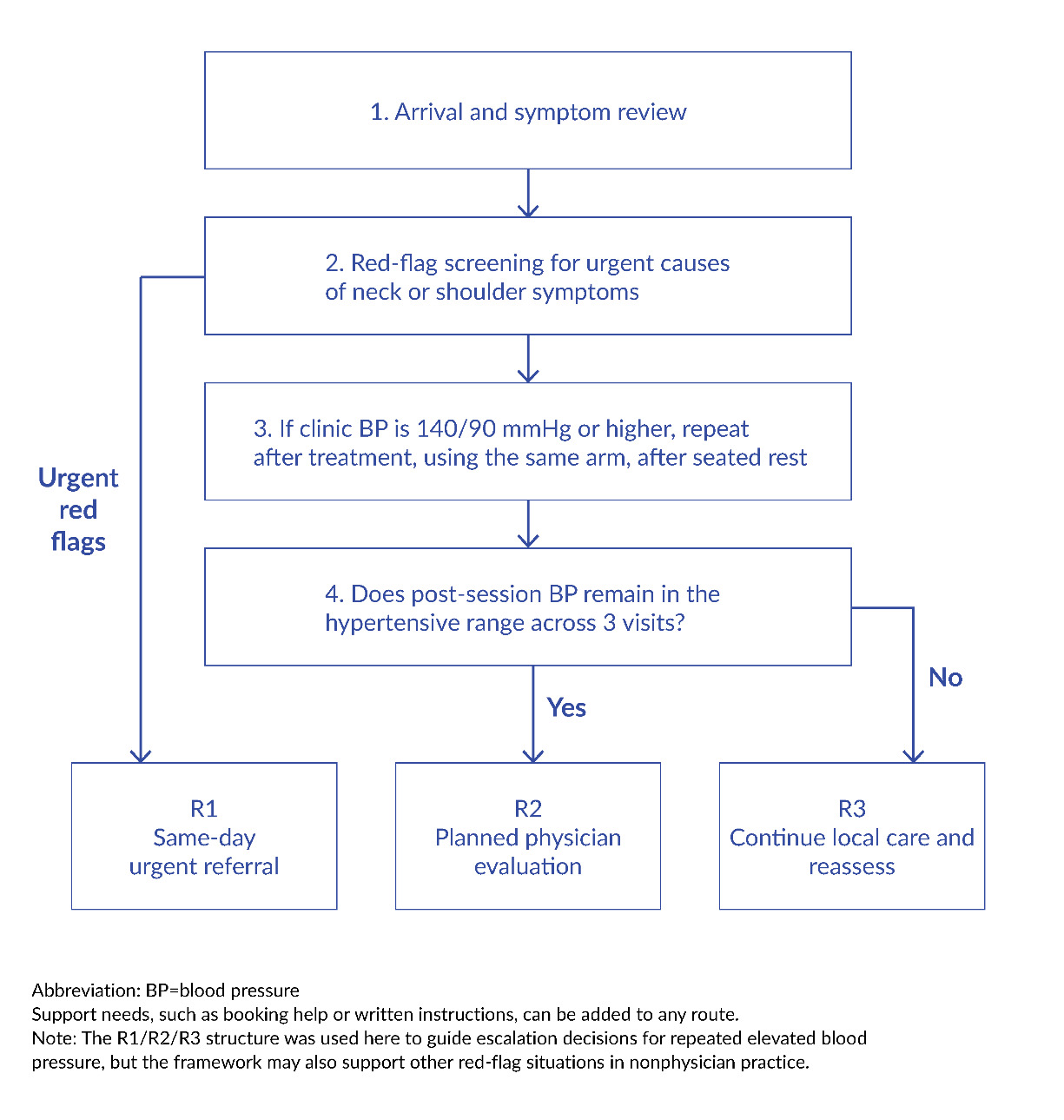
Assignment to R1 (same-day urgent referral), R2 (planned physician evaluation added while local conservative care continues), or R3 (continued local care with reassessment)
-
Documented follow-up and, when needed, referral with clinical information sharing
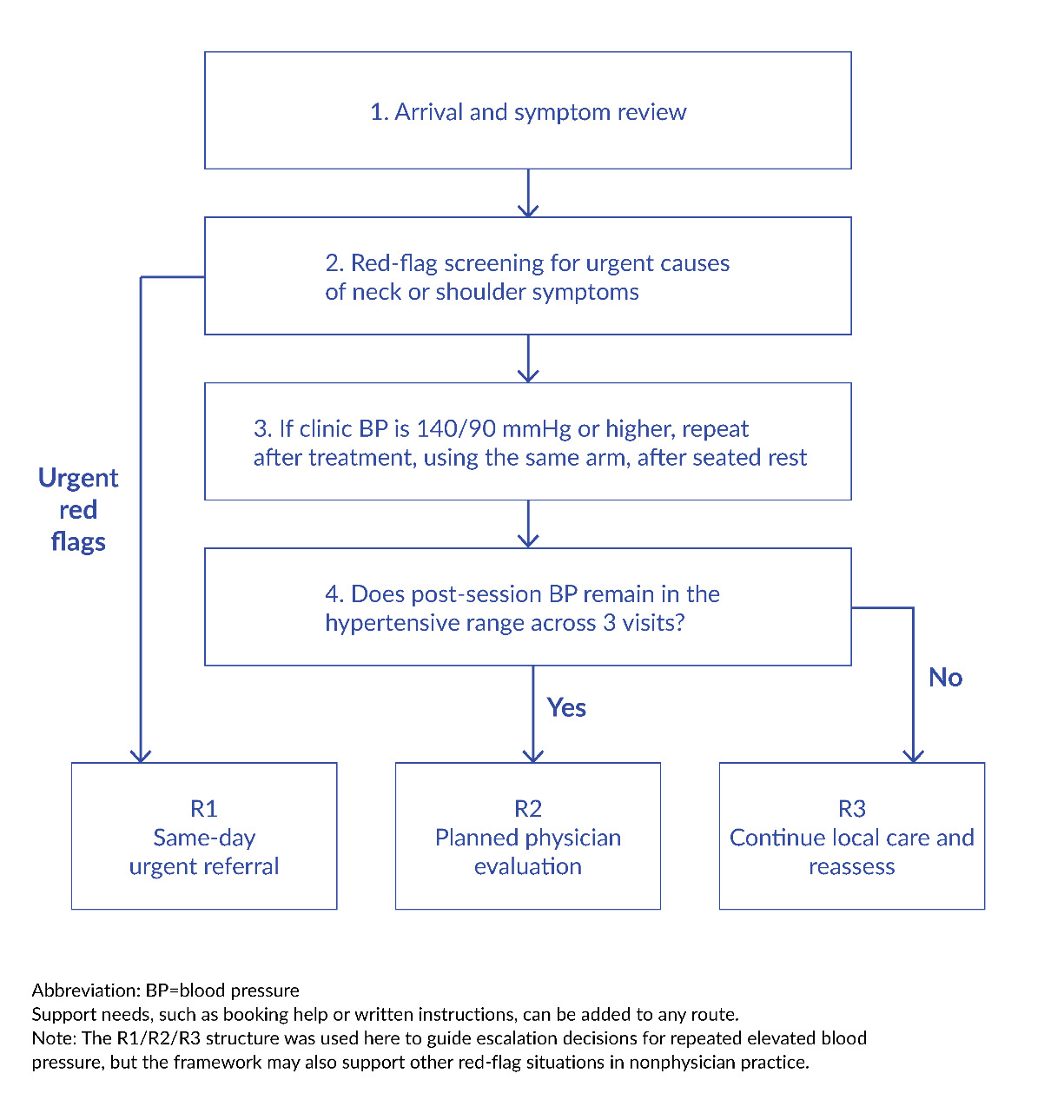
The R1/R2/R3 structure was not limited to blood pressure findings, but in this report it was used specifically to organize escalation decisions for repeated elevated blood pressure without acute red flags. (See Figure 1.)
Blood Pressure Measurement Procedure
Blood pressure was measured using an automated upper-arm blood pressure monitor that was used consistently in the clinic. For trend assessment, the comparison reading was obtained after treatment at a consistent post-session time point, after seated rest, using the same arm across visits.
An arrival blood pressure reading could be affected by haste, pain, or situational stress. Therefore, when the initial clinic blood pressure was 140/90 millimeters of mercury (mmHg) or higher, a repeat post-session reading was obtained under the standardized conditions described above. In this workflow, three visits with post-session readings in the hypertensive range triggered R2 planned physician evaluation, unless acute symptoms or severe findings required earlier R1 escalation.
Red-Flag Screening and Escalation Routes
Red-flag screening focused on urgent conditions relevant to neck and shoulder pain, including serious neurologic, infectious, malignant, or cardiac causes.6
R1: Same-Day Urgent Referral
Used when acute red flags were present, such as chest pain suggestive of ischemia, severe headache with concerning features, focal neurologic deficit, suspected sepsis, or marked blood pressure elevation with symptoms suggesting acute target-organ involvement. In this route, local care would be interrupted in favor of urgent medical evaluation.
R2: Planned Physician Evaluation While Local Conservative Care Continued
Used when repeated abnormal findings suggested a medical issue requiring physician assessment, but no immediate emergency features were present. In this case, repeated post-session blood pressure elevation without acute red flags triggered R2. Conservative acupuncture care for the presenting musculoskeletal complaint continued while physician evaluation was added.
R3: Continued Local Care With Scheduled Reassessment
Used when urgent red flags were absent and no repeated abnormal trend requiring referral had yet been established.
AI-Supported Organization and Documentation
A large language model was used only to support organization, documentation, and communication. It was used to help structure red-flag prompts, organize serial blood pressure readings, and summarize key referral information. All AI-generated text or structured outputs were reviewed, corrected, and finalized by the author.
AI was not used to make diagnoses, final urgency determinations, or treatment decisions. Instead, it supported the organization of clinical information for human interpretation and communication.4,5,7
In practical terms, AI was useful because it helped organize clinical information in a more consistent format across encounters. It also made red-flag review and referral preparation more reproducible in a small clinic.
Documentation and Auditability
For each relevant encounter, the clinic recorded the selected route, the clinical findings supporting that route, the actions taken, and the next review point. AI prompts and outputs used for communication were retained with the clinical record.
Case Presentation
A man in his 70s presented with a two-month history of right shoulder pain and gradually progressive stiffness. He retained active range of motion and reported no sudden trauma, fever, weight loss, night pain, chest pain, numbness, or weakness. He had no documented diagnosis of hypertension at presentation and had not recently consulted his primary care physician about blood pressure.
Physical examination suggested a musculoskeletal shoulder girdle problem without obvious neurologic deficit or signs of systemic illness. Because the presenting complaint involved the neck and shoulder region, the first priority was to exclude urgent red flags. None were identified.
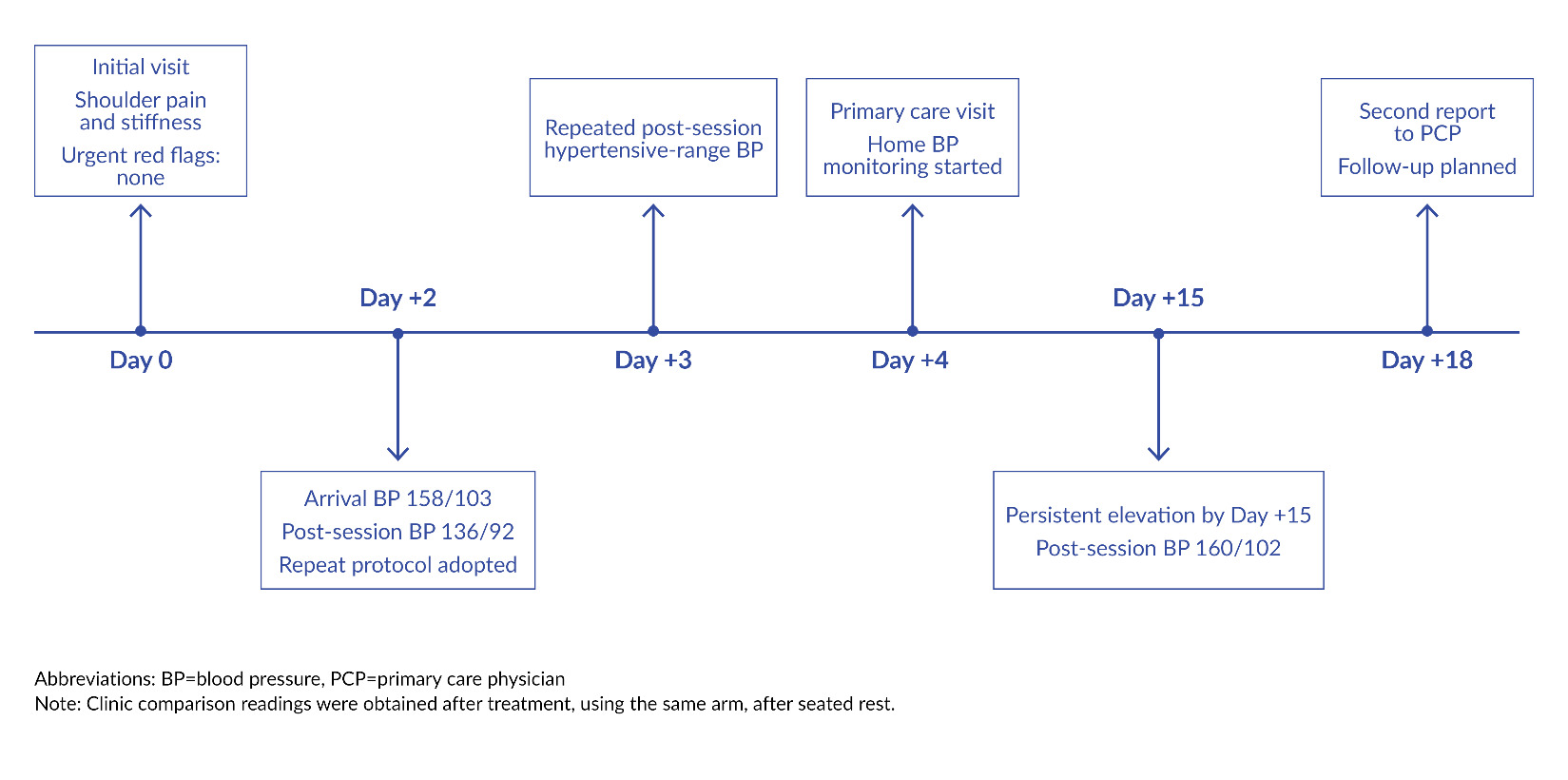
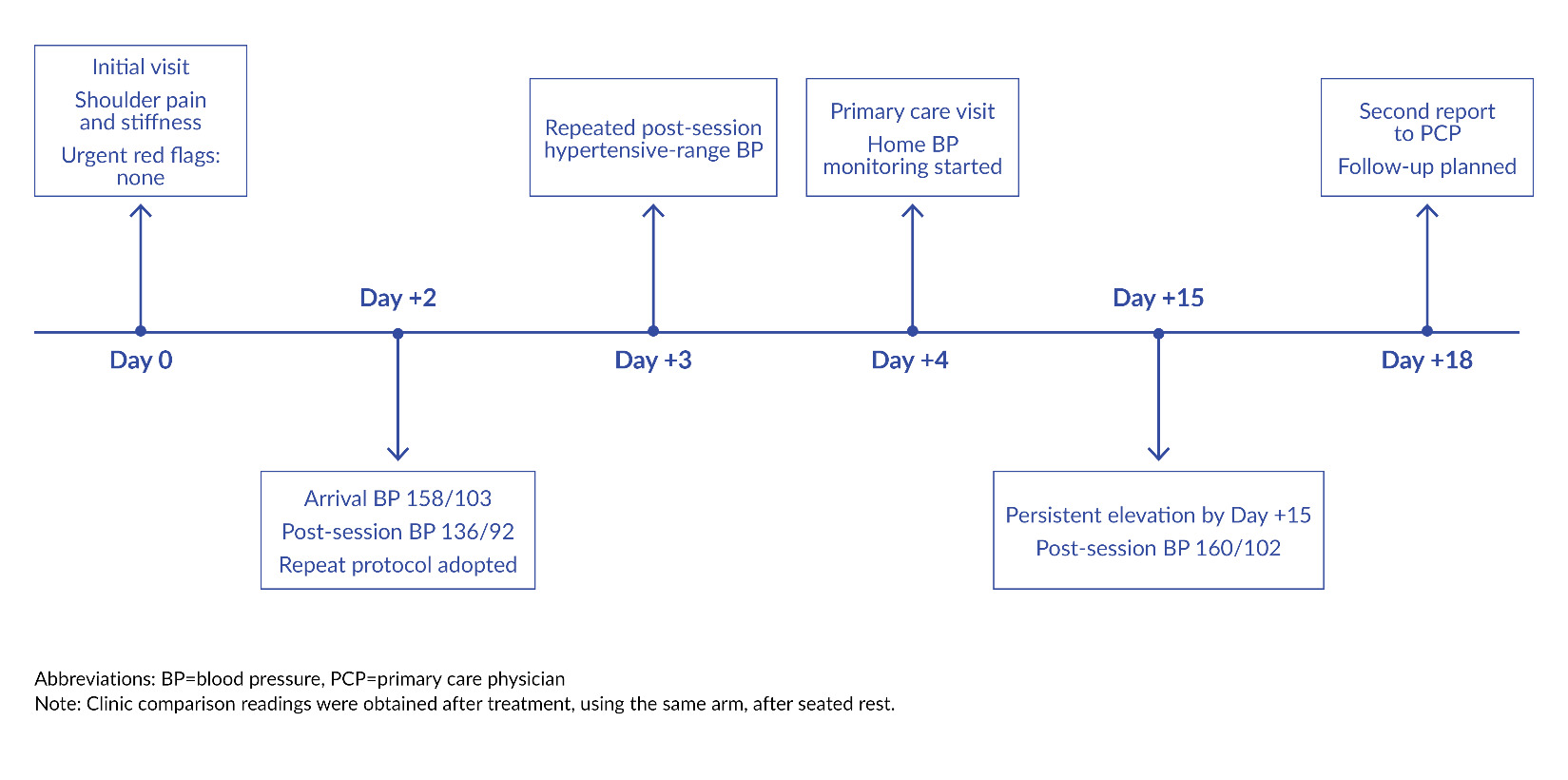
During the early course of care, the patient reported daily alcohol use and tobacco use. On Day +2, an arrival blood pressure reading was elevated at approximately 158/103 mmHg, with a heart rate of about 103 beats per minute, but he had hurried to the appointment. Following the clinic workflow, a repeat reading was obtained after treatment at the standardized post-session time point, after seated rest, using the same arm. That reading also remained elevated.
Conservative acupuncture care for shoulder pain continued, while post-session blood pressure was rechecked at subsequent visits using the same standardized method. The readings remained in the hypertensive range across multiple visits rather than returning to normal. Because this pattern persisted over three post-session measurements and no acute emergency features were present, the case met the predefined threshold for R2 referral. (See Figure 2.)
The patient reported that he did have a primary care physician, although he had not recently discussed blood pressure. After the repeated readings were explained, he agreed that physician review was appropriate.
Results
A brief referral note was prepared for the patient’s primary care physician. It summarized the chief complaint, the absence of urgent red flags related to the shoulder presentation, the repeated elevated post-session blood pressure readings, and the reason physician evaluation was recommended. It also clarified that the clinic’s role was limited to conservative pain care, repeat measurement, and referral support.
The patient subsequently attended a primary care visit. According to the patient’s report, the physician recommended home blood pressure monitoring and follow-up evaluation. Because the patient did not already have a home blood pressure monitor, the clinic assisted with the practical setup of home monitoring while conservative acupuncture care continued. No acute deterioration occurred during the observation period.
From a patient safety perspective, the workflow made it possible to document why referral occurred, when it occurred, and what information was handed off.
Discussion
Early Recognition of Possible Hypertension in a Nonphysician Setting
The main contribution of this case is not a claim that an acupuncture clinic diagnosed hypertension. It did not. The contribution is that a nonphysician clinic functioned as a structured point for early recognition of possible hypertension and referral to physician care, while conservative care for the presenting complaint continued.
This matters because elevated blood pressure is often asymptomatic. In a pain-focused setting, both clinician and patient may focus only on the musculoskeletal complaint. A repeat-measurement protocol helps distinguish a single, possibly situational reading from a repeated abnormal pattern that warrants medical follow-up. Without such a process, persistent hypertension in a community pain clinic could easily be dismissed as incidental.
Why a Clear Escalation Route Matters
The patient safety value here lies in moving from vague concern to explicit action. A defined R1/R2/R3 structure clarifies what should trigger urgent referral, what should trigger planned physician review, and what can reasonably remain under local observation. That helps reduce both overreaction and underreaction.
Although the R1/R2/R3 structure was designed as a general escalation framework rather than a blood pressure–specific tool, this report does not establish its effectiveness across other conditions. In the present case, it was used to organize escalation decisions for repeated elevated blood pressure without acute emergency features.
In this case, three features were especially important: standardized repeat measurement, a predefined R2 threshold, and a concise physician hand-off note. Together, these turned repeated abnormal readings into a clear referral decision.
Relation to Community Blood Pressure Literature
This report is far smaller in scope than the barbershop trial by Victor et al., which used a pharmacist-led treatment model in a specific community setting.2 However, both support a broader patient safety principle: Trusted repeated encounters outside conventional medical clinics can help identify elevated blood pressure and prompt follow-up.2,3
This case does not demonstrate improved blood pressure control. It demonstrates the feasibility of recognition, documentation, referral, and parallel conservative care in a nonphysician setting.
AI as an Aid for Organization and Communication
In this workflow, AI was used to support the structuring of red-flag prompts, the organization of clinical information, and the summarization of referral information for human review. That distinction is important. AI contributed to organization and communication, but final interpretation and action remained human.4,5,7
This was also important at a practical level. Repeat blood pressure measurement can be done without AI, but consistent organization of clinical information and referral preparation are more affected by variation in individual working style. In that sense, AI was not essential for detecting elevated blood pressure itself, but it was useful for making the workflow more reproducible in a solo clinic.
Limitations
This is a single case from a single clinic. The findings are therefore not strongly generalizable. In-clinic blood pressure measurements are also subject to device, technique, and situational variability, which is why physician-guided home or ambulatory monitoring remains necessary for diagnosis and management. In addition, repeat in-clinic measurements were obtained after seated rest at a consistent post-session time point, but the duration of seated rest was not formally standardized. The report does not show long-term blood pressure outcomes and does not prove improved clinical endpoints. It shows feasibility and patient safety logic.
Conclusion
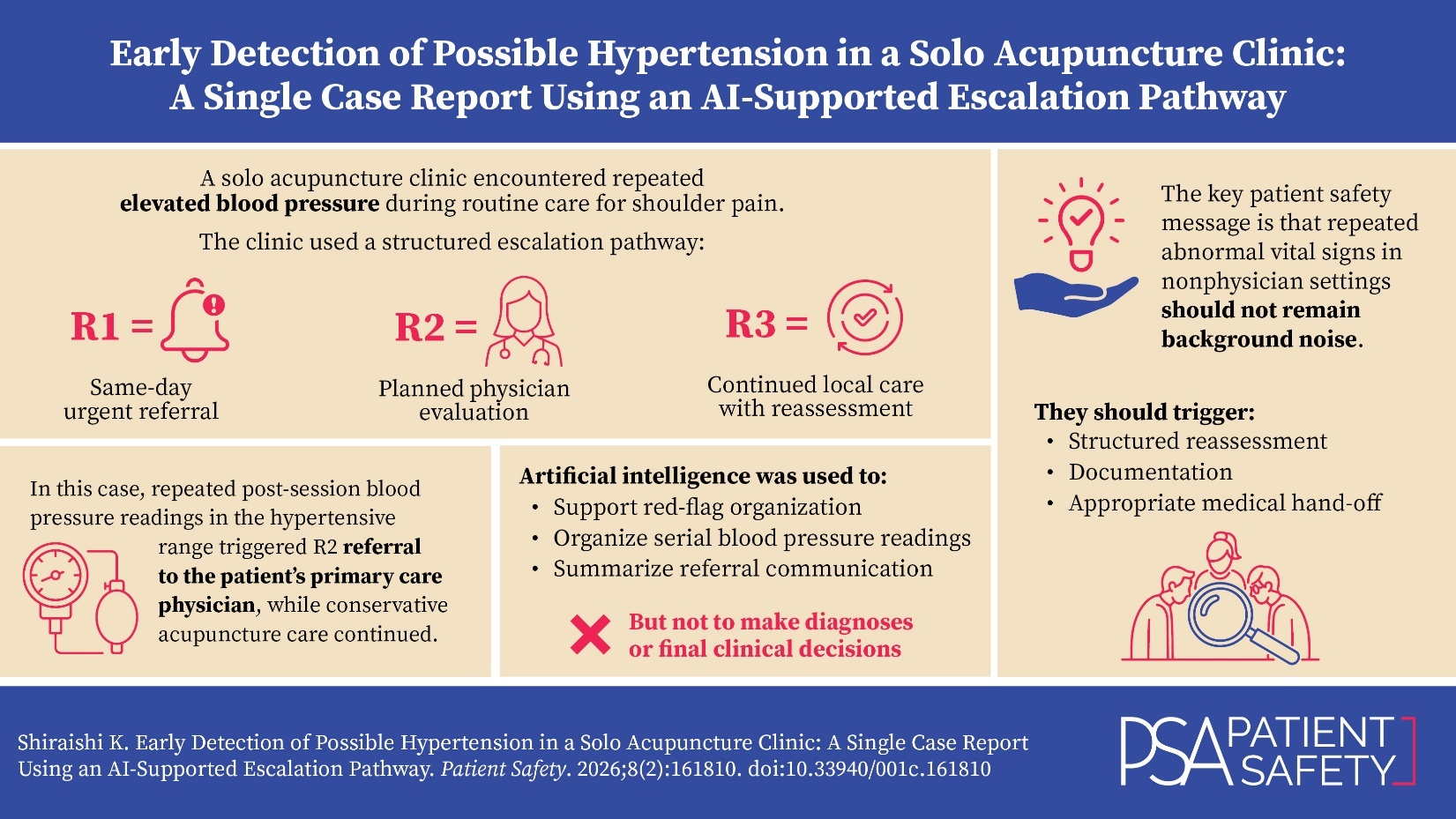
This single case suggests that a solo acupuncture clinic can function as a patient safety point for early recognition of possible hypertension when repeated blood pressure measurement, escalation criteria, and physician hand-off are explicitly structured. In this setting, AI was useful as an aid for red-flag organization, documentation, and communication within human clinical judgment. The key lesson is simple: repeated abnormal vital signs in a nonphysician setting should not remain background noise.
Disclosures
The author declares that they have no relevant or material financial interests.
Ethical Considerations
Written informed consent was obtained from the patient for publication of this anonymized case report.
Use of AI
The author used a large language model to help structure red-flag prompts, organize serial clinical information, and summarize key referral information. All outputs were reviewed and edited by the author. All final clinical judgments, including urgency and referral decisions, were made by the author.
About the Author
Kenjiro Shiraishi (kenjiroushiraishi@hotmail.co.jp) is an independent acupuncturist and director of Tanashi Kitaguchi Acupuncture and Moxa Clinic in Tokyo, Japan. His work focuses on acupuncture practice; patient safety; ethical, clinical decision-making; and the responsible use of artificial intelligence in clinical communication and research.