Falsifying data, fabricating references, peer-reviewing your own manuscript. There’s no shortage of ways that someone can damage the integrity of scientific research. Enter Ivan Oransky, MD, co-founder of Retraction Watch: an online database tracking published manuscripts that have been retracted for myriad reasons. Efforts like Retraction Watch are often some of the first—and last—lines of defense protecting knowledge and truth.
Cait Allen: You graduated from medical school, but your passion is more in publication and research.
Ivan Oransky: Yes, I earned a medical degree, but I’m always very careful that I do not purport to be practicing medicine. Whenever you think about how you became interested in something, it’s a bit of sharpshooter fallacy: You end up finding things that sort of confirm what you somehow thought.
My interest in journalism writ large comes from way back in high school. But in terms of the peer review process and scientific publishing, I had a tremendous experience when I was in medical school as the co-editor-in-chief of the medical student section of JAMA. They don’t have that anymore; this was 30-plus years ago. I got to spend a month at the AMA [American Medical Association] headquarters. George Lundberg was the JAMA editor-in-chief at the time, and he took me under his wing. I would go to peer review meetings. I have lots of criticism and questions about peer review, but at least what I saw there was best in class.
I became fascinated with how this whole process worked and what it told us about what we should do clinically, the respectful arguments and disagreements. That stayed with me and was an interest of mine even after I left medicine (my psychiatry internship to be a journalist).
Journalism as a field is increasingly seen as less trustworthy. As a professor, how do you try and navigate this with your students?
Unfortunately, real journalism is being done by fewer people now because the industry is under such financial and, frankly, political pressure. I’ve taught journalism for 25 years, and I’ve witnessed a change in what my students are concerned about. They often have a science or clinical background and are coming to train in medical, science, health, or environmental journalism. They’re pretty focused and do well in terms of jobs and internships.
But it’s a very challenging space. There are more people doing things that either want to look like journalism or are propaganda or misinformation, although I don’t love that term for various reasons. On balance, the democratization of the internet is a positive, but that’s more of a philosophical viewpoint.
I’m heartened when I see the research on nuance, headlines, and using more accurate language, that in small numbers here, but overall, readers, viewers, listeners seem to appreciate nuance and gaining some understanding.
Now, that’s counterbalanced by the influencers and undisclosed conflicts, and a lot of rage bait. So, I don’t know. I can say that I’m glad that I’m my age and my stage of career. I think if I were starting out again, I’d probably still do it, but I would be pretty concerned about how to really combine trustworthy, rigorous work with having a career that is satisfying and remunerates and compensates you in other important ways.
Speaking of trustworthy, you co-founded Retraction Watch. Tell us about that.
Retraction Watch really was born out of [co-founder] Adam Marcus’ reporting about someone named Scott Reuben, who was an anesthesiologist in Springfield, Massachusetts, at Baystate Medical Center. Adam broke this big story because he was the managing editor of Anesthesiology News at the time.
He got wind of this scandal that was affecting the literature. Reuben was studying rofecoxib and making up data in his clinical trials. At some point, the hospital realized he was fabricating all the data, and he was forced to retract 25 papers. He ended up going to federal prison for charges related to the misconduct. He paid restitution, and Adam did an amazing job with this story.
“Reuben was studying rofecoxib and making up data in his clinical trials. At some point, the hospital realized he was fabricating all the data, and he was forced to retract 25 papers. He ended up going to federal prison for charges related to the misconduct.”
I was really impressed. I knew Adam a bit, but I wouldn’t say we were friends at that point. But I said to him one day, “Look, there are all these retractions running around.” He and I would email and call each other. “Oh, isn’t that one interesting? Nobody’s talking about any of these—but they should be. Let’s start a blog.”
We had no idea how much this would grow. But it took off really quickly, and we’ve been having fun and making mischief ever since.
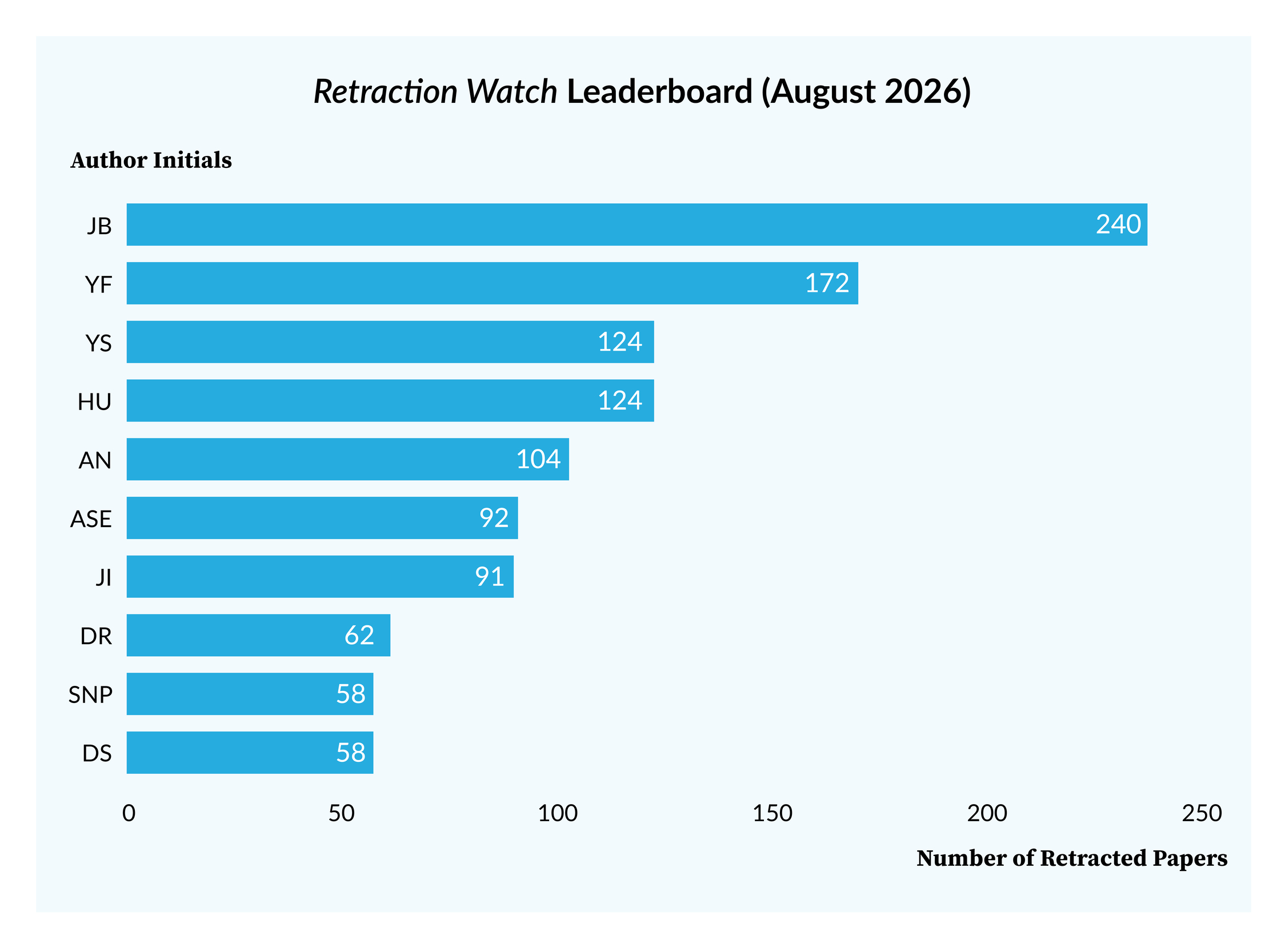
Speaking of making mischief, the Retraction Watch leaderboard tracks the authors with the most known retractions. It currently stands at 240. A lot of the folks on the leaderboard have had more papers retracted than most other people will even have published in their lifetime. How is that possible?
I like to put a slide of our leaderboard in talks and ask, “How many of you have published X papers?” And now I would have to say 241. Barely anyone responds—maybe the department chair. Then I’ll say, “Well, I’m sorry, none of you are ever going to make it to this list. I’m sure you’re crushed.”
.jpg)
In terms of your question, a reasonable follow-up is, “Well, how do you get to that many and still be doing science?” Most of them aren’t anymore. Retractions tend to drip out. If a large number of retractions emerges, it’s probably because there was an investigation at their university.
There can also be a clustering effect. Once somebody finds a problem in somebody’s paper, they’re going to look at everything else. It’s kind of like in journalism, a reader calls and says, “I didn’t say that, and that whole interview is made up.” Nowadays it’s AI [artificial intelligence] or was plagiarized from somewhere else. Most newspapers will then look at all that person’s work, and they will find other things.
You may also notice a couple other things about that list, right? One is that there are a lot of anesthesiologists on it. That’s because anesthesiology has been looking for problems in the literature the longest. And guess what? They found them. I think we should trust anesthesiology more for that, but that’s maybe another question or discussion. The other thing that you may notice is that there’s only one woman on the entire list of 30. Sometimes there aren’t any. Obviously, the list moves around.
“But if you have any kind of volume doing any human endeavor and you aren’t reporting any errors, then I don’t trust you.”
People have studied the overrepresentation of men. And it holds; it’s not just some artifact. Men are nine times more likely to have papers retracted for fraud. Sometimes people don’t like it when I mention that, usually men, but that’s how it is. And that’s been constant. There’s never more than one woman in that list of 30.
You mentioned anesthesia and how their willingness to report more should invoke more trust. In patient safety, there’s a sentiment that if you’re reporting more, it doesn’t mean your hospital is unsafe; it means you’re more transparent and you’re tracking things.
I’m suspicious if a hospital hasn’t reported any errors in a certain number of years. I’m not maligning healthcare. I was in training. My dad was a doctor; my grandfather was a doctor. But if you have any kind of volume doing any human endeavor and you aren’t reporting any errors, then I don’t trust you.
And you have to create a culture where anyone involved can raise a concern and it’s taken seriously. You don’t have to be the chief of surgery in the OR [operating room]. You could be somebody bringing in the next tray of instruments and say, “That doesn’t look right. Stop what you’re doing.”
And to your point, you have to normalize acknowledging mistakes and learning from them. Most errors in healthcare are unintentional. Two-thirds of retractions are due to misconduct. So, stigma is well earned.
“According to his research, it was saving lives. Mortality was lower if you were using this than if you weren’t, which is great. The problem was that that data was faked, and that’s why he now has 240 retractions.”
On the other hand, we need to normalize doing the right thing. We just announced the first winners of an award for that called Ctrl-Z [pronounced “control-zee,” in reference to pressing the control and Z keys on a keyboard to undo something]. We need to say, “Hey, everyone can raise their hand, and you should acknowledge these errors.” That’s how we get to a better place.
How does the retraction process typically occur?
I wouldn’t say there’s a typical process as much as there are more and less common routes to retraction. One of the key things that started 25 years ago is that everything was going online. Whether it was open access or not, enough people had access to the material and the necessary tools to find errors or even intentional fraud—whether it’s reverse engineering Photoshop or using placement detection software. It’s kind of like a screening test.
We have programs for sleuths of The Center for Scientific Integrity; they find a problem and write to the journal or the authors or the university. That prompts an investigation. Sometimes the journal notices something. Sometimes the authors themselves notice something. That’s usually a sort of “doing the right thing” kind of category.
But the issue is how long that takes, and is the process both rigorous and fair in terms of figuring out what’s going on? And that’s where one of our reasons for being is how long these processes take. And we think that it shouldn’t take as long as it does to correct the record. That’s, again, changing in a good way, but there’s still plenty of lag and still plenty that don’t get retracted at all.
Are you aware of any instances where patients were harmed because they were on the wrong end of bad science?
Yes. I’ll give a very specific example in anesthesia about Joachim Boldt, the record holder. Boldt’s main research focus was something called hetastarch, which is not a blood substitute. It’s a blood expander that kind of fools your body into thinking it has more blood than it does. It could be used for people who are having bypass surgery or other kinds of procedures that require a bypass machine; those machines just chew up your red blood cells.
And so, there’s a high need for transfusions. Obviously blood supplies being what they are, there are some risks there. Boldt was doing a lot of this research, and people were thrilled that companies were coming up with this substitute. According to his research, it was saving lives. Mortality was lower if you were using this than if you weren’t, which is great. The problem was that that data was faked, and that’s why he now has 240 retractions.
In 2013, someone took the meta-analysis and excluded his fraudulent research. And guess what? Not only did it not work, but it was killing people, which makes it all the worse. Not to condone making up data in any field, but it’s worse in a field where patients could be harmed. The authorities in Germany, where he is from, were considering criminal charges, I think for manslaughter. It was that serious. But they didn’t press those. Now, can I tell you which people died? Of course not. But it’s an example of this kind of fraud/misconduct causing real harm.
Did he have some kind of undisclosed financial interest?
I think in most cases, the real incentive is just the “publish or perish” incentive structure, the citation mania, the rankings. People get bored when I say that because they want a sexier answer. “Yeah, yeah. We’ve known that.” I’m like, “Yeah, we’ve known that. We’ve done nothing about it.”
However, it is also true that Boldt was receiving research funding from the makers of hetastarch. So that’s another incentive, no question. But I think people rush to assume a financial conflict of interest whenever there’s a problem. And that certainly plays a role. But at a high level, if you somehow got rid of all that, I think we’d still be left with most fraud and most retractions.
You celebrated Retraction Watch’s 16th anniversary in August. You’ve read thousands of papers over the years. Any stories that stand out?
There are so many stories. It’s like asking which one of your kids is your favorite. The right-but-not-satisfying answer is that every day we learn about some other variety on a theme or some new scheme people have come up with. That’s the sad part; people are applying their ingenuity to gaming the system instead of actually doing good science. And that’s bad. However, it makes for great stories. A storyline that I always come back to is people who managed to peer-review their own papers.
“I think people rush to assume a financial conflict of interest whenever there’s a problem. And that certainly plays a role. But at a high level, if you somehow got rid of all that, I think we’d still be left with most fraud and most retractions.”
It’s broadened now, but we first wrote about this in 2011 before we really knew what it was. In 2012, a plant biologist in South Korea had 28 retractions at once from three different journals, all the same publisher. All the retraction notices used the word “compromised.” We saw these retraction notices and said, “I’m not sure what’s going on, but here, readers, take a look at it.” Our readers are so on. They keep us honest. They find stuff. It’s terrific.
We often never find out. People don’t call us back. But we called the publisher, and the publisher said, “We’re glad you called.” Which is not what we usually get. But they said, “Listen, our lawyers said we’re not allowed to say all this in our retraction notice, but if those guys from Retraction Watch call, you could tell them what actually happened.” I’m like, “Okay, I don’t know what interpretation of defamation law that is, but good on you.”
They went on to explain that the author submitted all these papers to journals that requested suggested peer reviewers, which is not uncommon, particularly for small or niche journals; they always need peer reviewers. So, he filled in names. They were real names of other plant biologists who the editors would recognize, but he’d put in fake email addresses that all went to him.
So, he got all the invitations, did the reviews, and of course said, “You should accept these papers.” I stopped at that point and said, “That’s kind of brilliant. I mean, it’s evil-genius brilliant, but brilliant.” I asked how they figured it out, and they said it’s like leaving your getaway car outside the bank. Being that obvious is how you get caught. An editor became suspicious because all the reviews came back within 24 hours of the invitation. Not that he accepted the invitation within 24 hours. They all came back within 24 hours.
Then it made sense. It’s a big tell. You can’t even get people to respond that quickly, let alone get the review back in a day. It’s absurd. The editors investigated, and he confessed. After hearing this, I emailed him, and he actually wrote back. “The publisher’s saying you did this. How do you respond?” And he said, “I did it.” He admitted it. Then he added, “But it wasn’t my fault. It’s the editor’s fault because if they had been paying attention, I never would’ve gotten away with it.”
Which is a classic defense that never works. You go into a bank and rob it, and when you get arrested you say, “Yeah, here’s the money. I did it, but they didn’t hire a good security guard.”
I love telling that story because it combines several things: the pressure for peer reviews, using ingenuity in the wrong direction, and a flaw in the mechanics of these submission systems. Once we wrote about a couple cases like that; we did a big feature in Nature, which is still the most cited thing I’ve ever published. It’s hundreds of citations. It’s a very provocative headline, “Publishing: The Peer-Review Scam.” It’s kind of funny; a lot of people cite it because they want to beat up on peer review, but they clearly haven’t actually read it.
Like saying that “Born in the U.S.A.” is a patriotic song.
Exactly. Or my favorite, the episode of The Twilight Zone where at the end, the humans realize that To Serve Man is a cookbook. But once we published that in Nature, the submission systems patched that vulnerability. That’s the kind of way we measure impact, a publishing manuscript submission system patch or a new retraction.
This year’s theme for international Peer Review Week is the quantity of papers being generated, often by bots, which are bogging down editors. This threatens the sanctity of peer review and for manuscripts to be properly vetted before they become “the literature.” Peer review is such an important process, as flawed as it is, but it’s the best system we currently have.
It’s like what Churchill said about democracy. It’s “the worst form of Government except for all those other forms that have been tried from time to time.” Adam and I are occasionally asked to peer review papers about retractions. So, we believe in the process, but we need to be more honest about what peer review can and can’t do.
If publishers had to say what the one thing they do that adds value to the system is, it’s peer review. But once you start to chip away at how flawed peer review really is, that’s not just an epistemological question, it’s existential. Many are big multibillion-dollar companies. We need to be honest about that and say, “Look, peer review adds value. It doesn’t add as much value as we’ve always been taught it does.” It’s got some flaws, but it adds value.
Consider preprint servers, which are critically important. They’re also under strain, not in terms of peer review because they don’t do peer review, but because of the AI slop problem. AI’s here and is commonly used; the house is on fire. I don’t think we’re going to be able to control that fire. Or we’re going to put it out and not have a house anymore. But the house has always been somewhere between at risk of fire and actually smoldering.
“The author submitted all these papers to journals that requested suggested peer reviewers … They were real names of other plant biologists who the editors would recognize, but he’d put in fake email addresses that all went to him. So, he got all the invitations, did the reviews, and of course said, ‘You should accept these papers.’”
People like to point to the latest thing as the problem, and sometimes I know that the message or the stories either don’t resonate or people don’t want them to resonate. But I know that over time eventually it happens. So, I’m glad to hear that rather than, “Oh, it’s AI,” just say, “Wait, we have a volume problem.” We’ve always had a volume problem. The math didn’t work 10 years ago in terms of how many reviewers and hours and expertise you need and number of papers that are being shoved through the system.
So again, let’s be humble about what peer review can and can’t do and get stuff out there, put it in a preprint server, let others read it, but don’t write checks that peer review can’t cash. When people do ask me to speak at Peer Review Week, I preach humility. That sounds preachy as I say it, but I do think that humility in all endeavors is very important.
Any other thoughts about how AI could impact the validity of academic publishing?
Yes, there’s the volume problem. It’s not that I’m less concerned about the out-and-out fake stuff AI does. I am concerned about that, but it’s more the volume of purely useless stuff. It’s not wrong, it’s useless. We’ve reported on a number of these cases. People take a public dataset, throw up a few prompts, and then boom, have a meta-analysis or some kind of correlation study.
“People assume, not unreasonably, that acknowledging fraud or errors in science is what leads to lack of trust. But I would submit that it’s the failure to acknowledge those things. Nobody expects any system to be perfect, but if you keep saying it’s essentially perfect, I don’t think it serves us well.”
It floods everything with a lot of questions that aren’t even interesting. And even when they are, it’s going to get a bit wrong or just not be useful. Then you’re overwhelmed by slop. That’s a big problem. On the other hand, I think some of the AI tools can help. You want a human in the loop to decide whether something’s legit or not. But I’m happy to have an LLM [large language model] flag something as saying, “Hey, it ticked a bunch of boxes. You should look at this.”
What should an editor do if they suspect there’s an issue with a paper they published?
They should do something about it. I know that that’s obvious, but a lot of journals don’t; they find reasons not to. I would obviously discourage that. Ideally, you have someone who can do a proper investigation to really look at whatever the issue is. Some of the bigger publishers have teams of dozens of people who do this.
Every journal should have a set of procedures about what they would do before something ever happens. If you don’t have a team in-house, there are great consultants who do this kind of work. That’s the first step. I probably wouldn’t contact the authors right away. But if, in your estimation, there’s some reasonable likelihood that the paper’s going to need a significant correction or even retraction, you should flag it.
An “expression of concern” doesn’t adjudicate the final answer, but it says there’s something going on here. For example, Taylor & Francis has a little pop-up which says if something is under investigation. That’s all it says. They’re not meant to be permanent, and they don’t have their own DOIs [digital object identifiers] the way an expression of concern or retraction would. So that if someone comes across the paper, they know that something’s up and maybe they should just proceed with caution.
Like if you’re driving and you see construction. You shouldn’t pass over a massive pothole or drive off a bridge without extensive notice first. Now you may choose to, because you have some strange ideas about gravity or a sense of adventure. But I’m just concerned about whether you were warned ahead of time.
You can still cite a retracted paper or base your next set of experiments on a paper that’s under question, but you should go into it with informed consent. The problem is that this process takes so long in many cases or just never resolves that it’s a real disservice.
As you said earlier about the patients who were harmed by using that blood agent, if the warning signs aren’t posted, then there could be a lot of people who suffer real consequences as this process is playing out. So, it’s important to make sure people know that.
Yes, that’s right. We started the Medical Evidence Project with a very generous grant from Coefficient Giving. We want to focus on situations where there’s at least some reasonable likelihood people are getting harmed by whatever this error or fraud is. It just stands to reason. You want to clean up everything, but you’re going to prioritize cases that hurt people.
Is there anything else that is important to know?
Take a 30,000-foot view and try not to fall into the understandable, but harmful, human habit of not talking about things, of staying shtum. One of the arguments we get, particularly now given the pressure science is under, is “We shouldn’t talk about this stuff.” And I always respectfully disagree but also respectfully say there’s never a good or bad time to talk about something. And it’s the failure to talk about issues and confront them and be honest about them over time that creates the real problem.
People assume, not unreasonably, that acknowledging fraud or errors in science is what leads to lack of trust. But I would submit that it’s the failure to acknowledge those things. Nobody expects any system to be perfect, but if you keep saying it’s essentially perfect, I don’t think it serves us well. I don’t think it serves science well. And I just urge people to think about why we’re still at a point where more transparency would be better.
Disclosure
The authors declare that they have no relevant or material financial interests.
About the Authors
Ivan Oransky is co-founder of Retraction Watch; executive director of its parent nonprofit, The Center for Scientific Integrity; editor-in-chief of The Transmitter; and a distinguished journalist in residence at New York University’s Arthur L. Carter Journalism Institute.
Caitlyn Allen (caiallen@pa.gov) is director of External Affairs for the Patient Safety Authority (PSA) and managing editor for Patient Safety, the PSA’s peer-reviewed journal. Before joining PSA, she was the project manager for Patient Safety at Jefferson Health, where she also was the only nonphysician elected to serve on the House Staff Quality and Safety Leadership Council.